





Ihram Rules for Men and Women: What to Wear, Do and Avoid
Sunnah preparations, Ihram clothing for men and women, what is forbidden and allowed, and what to do if you make a mistake.
Ihram is the sacred state a pilgrim enters for Umrah or Hajj. It does not begin when you put on two white sheets, but when you make the niyyah (intention) and recite the Talbiyah at or before the Miqat. From that moment some everyday things become forbidden until your Umrah is complete. This guide explains the rules for men and women as they are generally taught in the Hanafi school, noting where other schools differ. For your own circumstances, please ask a trusted scholar.
Sunnah preparations before Ihram
- Grooming: clip your nails, trim the moustache and remove underarm and pubic hair beforehand, as none of this is allowed once you are in Ihram.
- Ghusl: take a full bath with the intention of Ihram. It is Sunnah even for a woman who is menstruating or has post-natal bleeding: the Prophet Muhammad ﷺ told Asma' bint 'Umays, who had just given birth, to bathe and enter Ihram (Sahih Muslim). If a bath is not possible, wudu is enough.
- Perfume, for men: it is Sunnah to apply perfume to the body, not to the Ihram sheets, before making the niyyah. 'A'ishah (may Allah be pleased with her) said she perfumed the Prophet ﷺ for his Ihram before he entered it (Sahih al-Bukhari, Sahih Muslim). Women should avoid fragrance that others can notice and use unscented products.
- Two rak'ahs: pray two rak'ahs with the intention of Ihram, provided it is not a time in which prayer is disliked. Many pilgrims pray them at home or at the airport. A woman on her period does not pray them.
- Niyyah and Talbiyah: then make the intention for Umrah and recite the Talbiyah. Only now are you in Ihram.
What men wear
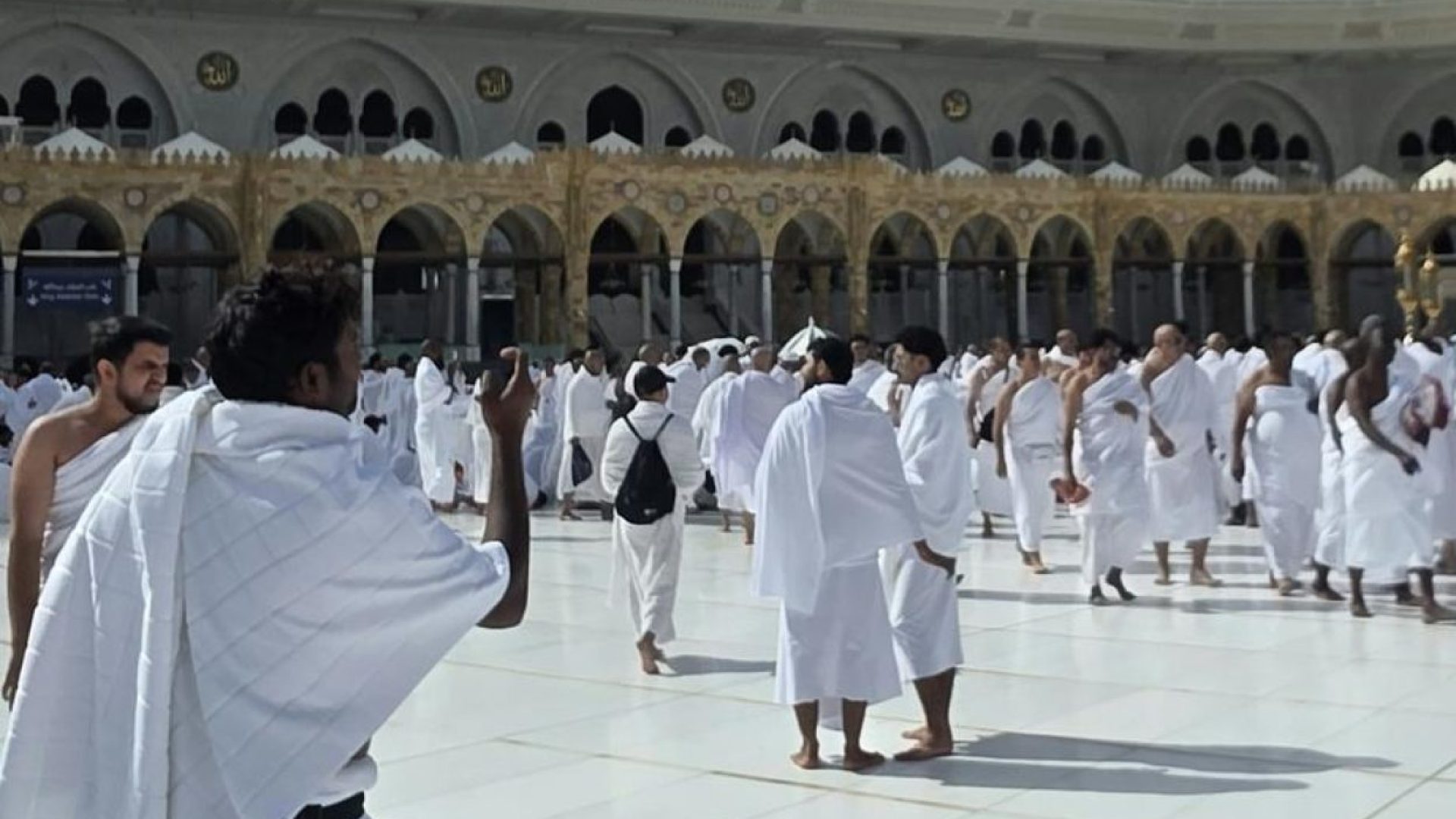
- Two unstitched sheets: the izar, wrapped around the waist and covering at least from the navel to below the knees, and the rida', over the shoulders. Clean white sheets are preferred.
- Nothing stitched or shaped to the body: no shirt, trousers, kurta, vest, underwear, socks, cap or turban.
- The head and face stay uncovered.
- Footwear: in the Hanafi view it must leave the raised bone on the top middle of the foot uncovered. Ordinary sandals or hawai chappals are fine; closed shoes are not. Other schools word this rule differently.
An Ihram belt with pockets, to hold the izar in place and carry money, is widely used and allowed.
What women wear
- Ordinary, loose, modest clothes of any colour. There is no special Ihram dress, and white is not required. Stitched clothes, socks and closed shoes are all fine.
- The hair and body are covered as usual.
- The face and hands are left uncovered: no niqab or veil touching the face. The Prophet ﷺ said that a woman in Ihram should not wear a niqab or gloves (Sahih al-Bukhari). Scholars differ on the details regarding gloves; avoiding them is the safer course.
- Many women who wish to screen their face from non-mahram men keep a cloth held away from the face, for example by wearing a peaked cap under the scarf so that the cloth does not touch the skin.
Forbidden in Ihram for men and women
- Cutting, shaving or plucking hair from any part of the body.
- Clipping nails.
- Perfume or scented products on the body or clothes: attar, scented soap, shampoo, scented wipes and creams. The Black Stone and the walls of the Kaaba are often perfumed, so scholars advise pilgrims in Ihram not to touch them.
- Marital relations and anything leading to them, such as kissing or touching with desire.
- Obscene talk, arguing and sin. The Qur'an says there is to be no indecency, wrongdoing or quarrelling in Hajj (2:197); these are always wrong, and more serious in Ihram.
- Hunting or disturbing wild land animals. Within the Haram boundary, cutting its trees and plants is not allowed for anyone, in Ihram or not.
- Men only: stitched clothing, covering the head or face, and footwear that covers the bone on top of the foot.
- Women only: covering the face with something that touches it, and gloves, as mentioned in the hadith.
What is allowed
- Bathing and washing with water and unscented soap. Wash gently, without rubbing hard.
- Changing into a fresh set of Ihram sheets, or washing them. Taking the sheets off does not end Ihram; it is a state that lasts until your Umrah is complete.
- A belt or money pouch, a watch, spectacles and a ring.
- Shade from an umbrella, a tent, a vehicle roof or a building. What men may not do is put something on the head that covers it, such as a cap or a cloth.
- Covering the body with a blanket while sleeping, as long as a man keeps his head and face uncovered.
- Using a miswak or toothbrush, and taking any medicine or treatment you need.
If a prohibition is broken by mistake
Mistakes happen, especially on a first journey. The Shariah provides expiations for breaches of Ihram, so do not panic or assume your Umrah is ruined.
- Stop at once: take off the cap, wash off the perfume, uncover the face.
- Note exactly what happened, how much and for how long, because the ruling depends on these details. Depending on the act, the expiation may be charity (sadaqah), fasting, or an animal sacrifice (dam) within the Haram.
- Ask a qualified scholar before you leave Makkah. In the Hanafi school an expiation can be due even for a genuine mistake, though there is no sin in it; other schools excuse some acts done out of forgetfulness or ignorance. Do not rely on rulings forwarded on social media.
- Marital relations before the Umrah is complete is the most serious breach and can invalidate the Umrah. In that case, consult a scholar immediately.
Women and menstruation
A woman whose period has started can still enter Ihram: she bathes for cleanliness, makes the niyyah and recites the Talbiyah, but does not pray. She should not perform Tawaf until she is pure. If your travel dates may make this difficult, discuss it with a scholar before you travel.
Travelling with us
If you travel with Umrah with Ateeq, our group leaders can help with practical questions about Ihram along the way, in Urdu and English; for rulings, please ask a scholar. Our free Umrah guide and packing checklist are on the resources page, and you can explore our Umrah packages or contact us with your questions.

Related Posts

Leave a comment
Your email address will not be published. Required fields are marked *